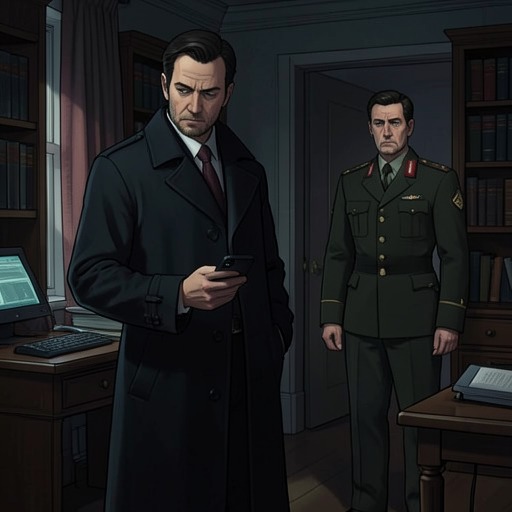
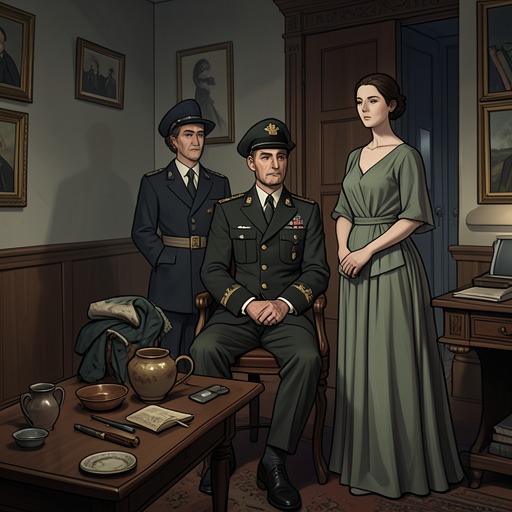
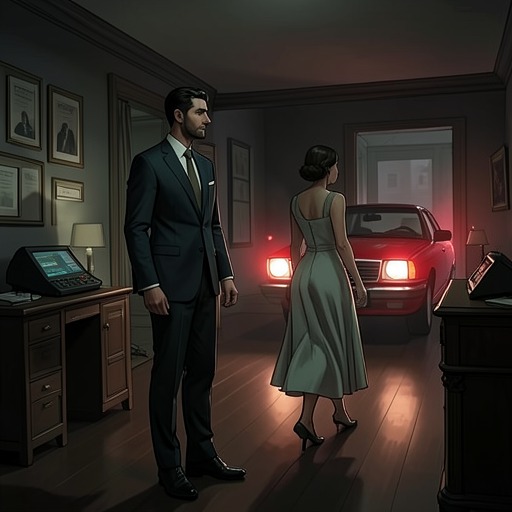
General Sternwood rehires Marlowe to find Rusty Regan
The Big SleepGeneral Sternwood rehires Marlowe to find Rusty Regan after Marlowe admits that the investigation is unfinished by his own standards. The General offers another thousand dollars for a limited but deeply personal answer: he does not require Regan to return or even to disclose where he is, only to confirm directly that he is all right. This renewed commission brings the investigation back to its original purpose and ends the novel with a search still open.
Background: An Investigation Left Unfinished
Marlowe’s first commission came from the General, who wanted him to look into the disappearance of Regan, his son-in-law and a man he had taken a particular liking to. Marlowe’s visit to the Sternwood estate began with the polished presentation of a private detective calling on great wealth; the case that followed entangled him in Geiger’s blackmail scheme, Carmen Sternwood’s photographs, and the killings of Geiger and Joe Brody. The apparent solution to those crimes did not solve the question that mattered most to the General: what had happened to Regan.
The gap between the investigations is marked by a change in what Marlowe is willing to claim. When Captain Cronjager reproaches him for not reporting Geiger’s murder, Marlowe concedes that he had wanted to protect his client and had not expected the consequences that followed. Cronjager points out that the delay helped set in motion events leading to Brody’s death. By the time Marlowe returns to the General, he has come to see his handling of the case as a failure against his own professional measure, even though the family’s immediate scandal has been contained.
The Renewed Commission
Marlowe says he has quit and has been warned off; he also offers to return the General’s money because, by his standards, the job is not complete. The General rejects the resignation and offers another thousand dollars to continue the search. His terms are deliberately different from a demand to bring Regan back: Regan may live his own life, and the General says he would not blame him for leaving his daughter, even abruptly. What he wants is confirmation from Regan himself that he is safe. If Regan needs money, the General wants him to have it.
The request makes the emotional purpose of the commission plain. Marlowe has told the General that Regan mattered to him more than the money or even the General’s daughters, and the General does not dispute that reading. He calls himself sentimental and admits that he took a fancy to Regan, whom he had considered decent. His concern also carries self-doubt: he wonders whether he was too vain about his own judgment of character. The search is therefore not simply a practical effort to locate a missing man; it is the General’s attempt to know whether his affection and trust were misplaced.
What the Search Conceals
The renewed assignment begins under the weight of clues that point in different directions. Captain Gregory recalls that Regan disappeared on September 16, when the chauffeur was off duty, and that Regan’s car was found four days later in a garage at Casa de Oro, a bungalow court near Sunset Towers. Police could not establish who had put it there or find usable fingerprints. The car’s presence seemed inconsistent with foul play, while other circumstances left reason to suspect it; a possible sighting of a man resembling Regan with Eddie Mars’s missing wife further clouded the account.
The book’s final revelation overturns the apparent possibility that Regan simply left. Marlowe tells Vivian that on the day Regan disappeared, he had taken Carmen to old oil wells to teach her to shoot. While she was meant to fire at a can, she turned the gun on Regan and shot him. The discovery explains the disappearance as a concealed death rather than a voluntary departure, but it does not become the answer Marlowe gives the General. The rehire is thus charged with dramatic irony: the General commissions a search for a man whose fate Marlowe has uncovered, while Marlowe continues to withhold the truth in order to protect the Sternwoods.
An Open-Ended Duty
The renewed commission does not end with Regan found or the General reassured. Marlowe accepts the request and tells him to rest, but the reader knows the General’s hope cannot be fulfilled in the simple form he imagines. The contrast between the General’s wish for direct confirmation and Marlowe’s knowledge gives the final assignment its moral tension: professional service now means preserving a client’s hope by withholding the fact that would destroy it.
That tension returns in Marlowe’s closing reflection on death. He imagines Regan as sleeping the “big sleep,” indifferent to where his body lies, and recognizes that he himself has become part of the surrounding nastiness, while the General need not yet know its full extent. The renewed search therefore closes the narrative loop without resolving the case in the General’s terms. It restores Marlowe to the work he was hired to do, but leaves the difference between finding the truth and telling it at the center of his duty.